
English| EUR
Suggested for you
More currencies
Choose a language
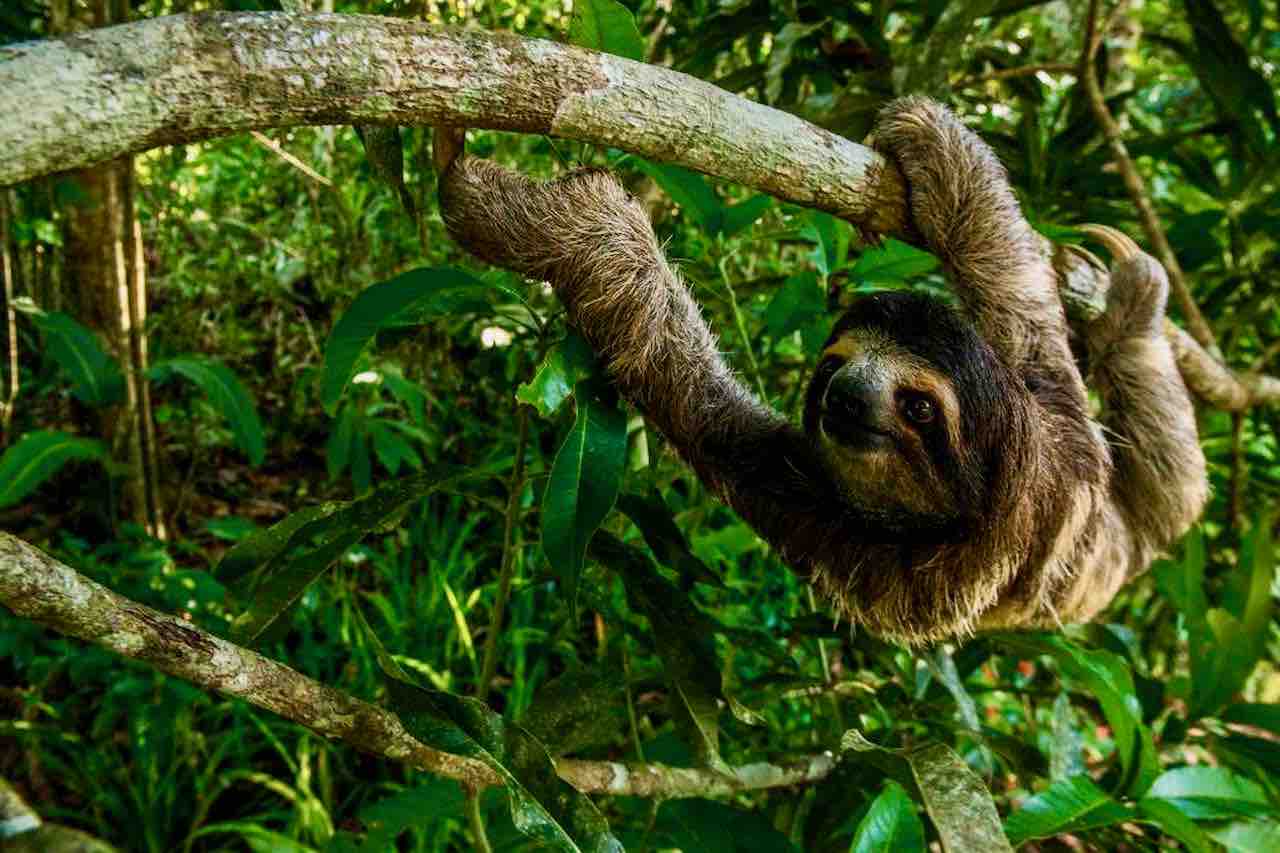
Gamboa Rainforest Reserve, 40 minutes from Panama City, is home to both two-toed and three-toed sloths in 340 hectares of protected lowland forest along the Chagres River. Guided tours bring visitors within meters of wild sloths in their canopy habitat.
Quick answer
The best place to see sloths in Panama is Gamboa Rainforest Reserve in Colón Province, where naturalist-led tours traverse primary rainforest habitat occupied by both Bradypus variegatus (three-toed) and Choloepus hoffmanni (two-toed) sloths. The reserve operates Tuesday through Sunday from 10:00 to 16:00, with a 25 USD conservation fee per person plus 7% tax.
Two-toed sloths sleep 15 hours a day, descending from the canopy only once a week to defecate at the base of a single chosen tree. That constraint makes reliable sloth sightings rare in unmanaged forest—but Gamboa Rainforest Reserve's network of interpretive trails and trained naturalist guides have turned the reserve into the most dependable sloth-watching destination in Central America. The reserve protects 340 hectares of Chagres River lowland rainforest where cecropia trees—the preferred browse of three-toed sloths—form dense stands along the canopy edge. Two-toed sloths, by contrast, range higher and feed on a broader diet of leaves, fruits, and shoots. Both species are present year-round, though activity peaks in the early morning and late afternoon when ambient temperatures moderate. Gamboa's one-hour guided tours follow elevated boardwalks and packed-earth trails that minimize disturbance to the understory while offering sightlines into the mid-canopy feeding zone. Sloth ecology shapes every element of the visit. Bradypus variegatus moves at a maximum speed of 0.24 kilometers per hour and relies on cryptic coloration—its fur hosts symbiotic algae that tint it green during the wet season—to avoid predation by harpy eagles. Choloepus hoffmanni, the larger two-toed species, is nocturnal and more difficult to spot during daylight tours, though guides use radio telemetry data from ongoing research projects to increase encounter rates. The reserve's commitment to low-impact visitation means group sizes remain small and approach distances are regulated. Visitors looking for where to see sloths in Panama should note that Gamboa is not a captive facility—sightings depend on weather, season, and the animals' natural behavior. The reserve recommends arriving between 10:00 and 14:00 to allow time for the full tour circuit before the final departure shift. Binoculars are provided, and the terrain is accessible to most mobility levels. The conservation fee supports habitat restoration and the ongoing sloth monitoring program led by the Smithsonian Tropical Research Institute, whose field station adjoins the reserve.
“Gamboa's naturalist-led trails offer the highest probability sloth encounter rate of any accessible rainforest site in Panama.”
The Gamboa Rainforest facility operates on a regular weekly schedule, welcoming visitors Tuesday through Sunday. It remains closed every Monday.
The sanctuary is located at the Gamboa Rainforest Reserve in the Corregimiento de Cristobal, Colon. Reaching the site is most efficiently achieved by private vehicle or taxi from Panama City.
Avenida Omar Torrijos Herrera toward Gamboa
Direct service from Panama City to Gamboa Rainforest Reserve
Plan your travel to arrive within the 10:00–14:00 window to ensure sufficient time for the one-hour tour. Upon arrival, proceed to the main reception of the Gamboa Rainforest Reserve for assistance.
This plan suits visitors arriving mid-morning and centers on the guided sloth tour, which runs for one hour. Allow three to four hours total for the full experience, including forest exploration and the return journey.
Check in at the visitor center and confirm your tour slot. The reserve opens at 10:00 Tuesday through Sunday, with the final tour departing by 15:00.
The one-hour naturalist-led walk takes you through primary rainforest where sloths feed and rest in cecropia trees. Guides use spotting scopes to bring animals into close view.
After the tour, follow the marked paths that loop through the reserve's lowland forest. Sloths are often visible from the observation platforms without a guide.
The landscaped garden near the entrance showcases native epiphytes and offers shaded seating. It's a short detour before you depart.
The drive back takes 45 minutes. Departing by early afternoon ensures you avoid the return commuter traffic on the Gaillard Highway.
The best arrival window is 10:00–14:00. This timeframe provides sufficient duration to complete the 1-hour tour before the final shift begins.
—
Visiting mid-week during morning hours offers the quietest experience for observation.
—
Expect more guests during these periods, which may impact the pace of tours.
Warm with moderate humidity
This season sees more visitors but provides consistent conditions for outdoor exploration.
High humidity and frequent rain
Lower visitor density often results in smaller group sizes for tour participants.
Verdict: The optimal period to visit is Tuesday to Thursday between 10:00 and 14:00 during the months of May or November.
The Gamboa region provides a habitat for specific sloth species within the Panamanian rainforest. These arboreal mammals possess unique biological traits adapted for life in the canopy.
Visitors in the Gamboa region may encounter both the brown-throated three-toed sloth and the Hoffmann's two-toed sloth. These species coexist within the same tropical ecosystem.
Sloths possess one of the slowest metabolic rates among mammals, which allows them to survive on a low-energy diet of leaves. This adaptation requires them to spend a significant portion of their day resting.
Sloths spend nearly their entire lives in trees, coming to the ground only rarely, often to defecate or move between non-connected trees. Their anatomy is specialized for hanging and climbing rather than walking.
The fur of a sloth often houses symbiotic algae, which provides a greenish tint that acts as camouflage against the forest canopy. This relationship also hosts various insects that live within the sloth's coat.
While wild sloths were once thought to sleep for 20 hours a day, recent studies suggest they sleep closer to 10 hours in their natural environment. Their inactivity is more a result of energy conservation than constant sleep.
Everything you need to know about where to see sloths in panama
The Gamboa Rainforest Reserve offers a unique opportunity for those wondering where to see sloths in panama within their natural ecosystem. Guided tours provide educational insights into these arboreal mammals and their conservation. Visitors can observe the sanctuary from a controlled environment to ensure the safety of the animals.
For a successful trip to a sloth sanctuary panama, plan your visit between Tuesday and Sunday. Arriving mid-morning allows you to avoid the busiest periods and participate comfortably in scheduled tours.
The entrance fee is 25 USD per person, plus a 7% tax. This conservation fee supports the maintenance of the habitat and the ongoing protection of local wildlife.
The center operates from Tuesday through Sunday, with the site closed every Monday. Please ensure you plan your itinerary to align with these active days to avoid disappointment.
The best arrival window is 10:00 to 14:00. This timeframe provides sufficient opportunity to complete the 1-hour tour before the final daily shift begins.
Yes, families often choose this location when researching where to see sloths in panama. The facility provides an accessible way for children to learn about biodiversity in the tropical canopy.
The site is located in the Gamboa Rainforest Reserve. Guests should arrange private transport or a shuttle service to reach this specific address in the Corregimiento de Cristobal.
Sloth Sanctuaries Near Panama City
Read more Tickets & toursGuided Sloth Sanctuary Tours
Read more GuideAre There Sloths in Panama?
Read more Tickets & toursSloth Sanctuary Panama Tickets & Tours
Read more GuideSloth Sanctuary Panama Prices & Entry Fees
Read more GuideGamboa Sloth Sanctuary Visitor Guide
Read more